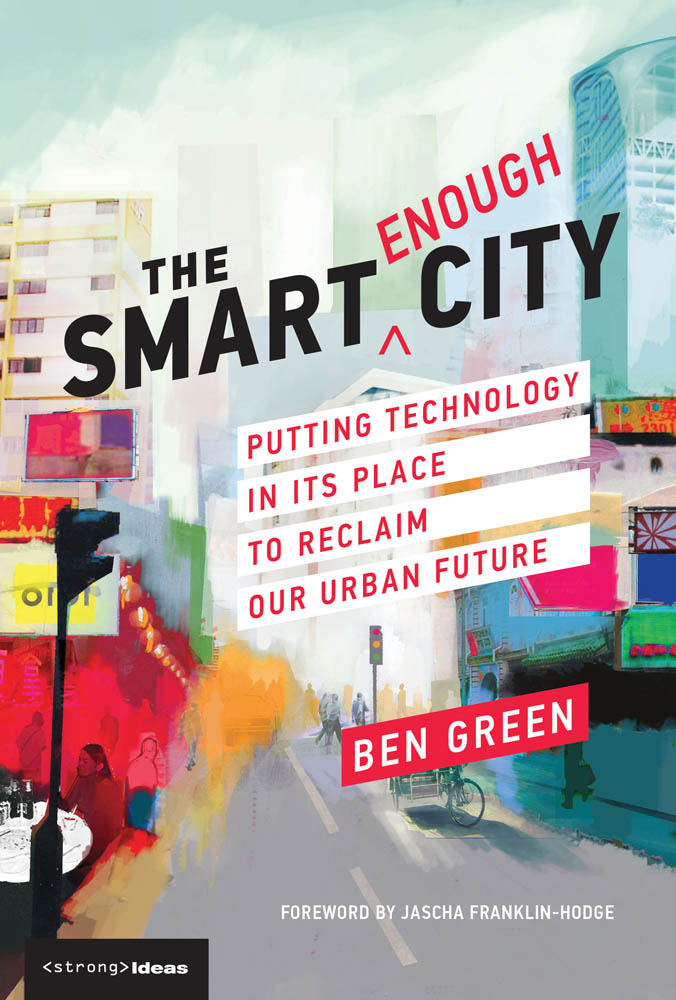
The Smart Enough City
“deeply thoughtful, thoroughly ethical, and technically precise … a must-read for those seeking democracy and inclusion in technological advance.” ―Frank Pasquale
“provides a new framework for social responsibility in tech not rooted in abstract ethical tenets but grown from practices he put to the test himself.” ―Mary L. Gray
“gives a road map for ethical and democratically engaged innovation.” ―Beth Coleman
“I never imagined that I would find a book about cities so engaging.” —Stephen Few
“forces us to see how thinking critically about data means looking beyond the mirage of objectivity.” —Boston Review
“a eulogy for modest, incremental improvements that put the public interest ahead of … algorithmic solutions.” —Public Books
Order the book: MIT Press | Amazon | Bookshop | Barnes & Noble
Read the open access edition: MIT Press Direct | PubPub
Why technology is not an end in itself, and how cities can be “smart enough,” using technology to promote democracy and equity.
Smart cities, where technology is used to solve every problem, are hailed as futuristic urban utopias. We are promised that apps, algorithms, and artificial intelligence will relieve congestion, restore democracy, prevent crime, and improve public services. In The Smart Enough City, Ben Green warns against seeing the city only through the lens of technology; taking an exclusively technical view of urban life will lead to cities that appear smart but under the surface are rife with injustice and inequality. He proposes instead that cities strive to be “smart enough”: to embrace technology as a powerful tool when used in conjunction with other forms of social change—but not to value technology as an end in itself.
In a technology-centric smart city, self-driving cars have the run of downtown and force out pedestrians, civic engagement is limited to requesting services through an app, police use algorithms to justify and perpetuate racist practices, and governments and private companies surveil public space to control behavior. Green describes smart city efforts gone wrong but also smart enough alternatives, attainable with the help of technology but not reducible to technology: a livable city, a democratic city, a just city, a responsible city, and an innovative city. By recognizing the complexity of urban life rather than merely seeing the city as something to optimize, these Smart Enough Cities successfully incorporate technology into a holistic vision of justice and equity.
Excerpts/Op-eds
Smile, Your City Is Watching You (The New York Times)
The Biggest Mistakes Cities Make in Their Quest to Be Smart (Wall Street Journal)
Can predictive policing help stamp out racial profiling? (Boston Globe Magazine)
Cities Are Not Technology Problems: What Smart Cities Companies Get Wrong (Metropolis Magazine)
Reviews/Q+As
The Sins of “Smart” Cities (Boston Review)
The allure of technology into the “utopia” of the Smart City (Tapuya journal)
Can Smart Cities Be Equitable Cities? (Public Books)
Cities Too Smart for Their Own Good? (Harvard Magazine)
Putting technology in its place in the ‘smart enough’ city (Bloomberg Cities)
‘Smart city’ technology alone cannot solve social problems (StateScoop)
The Smart Enough City: Avoiding the Myopia of Tech Goggles (Stephen Few blog)
Move Carefully and Test Things (City as a Service)
A Talk with Smart City Skeptic, Ben Green (RedTail)
The “Smart Enough” City (Harvard Law Today)
Towards politically smart cities (InternetActu.net)
Out and about in London this weekend? Chances are you’re probably being tracked (The Evening Standard)
Interview on Techtonic with Mark Hurst (July 6, 2020)
In conversation: Ben Green on Smart (Enough) Cities (Current Affairs Podcast)
A More Inclusive Approach to Smart Cities (WashingTech Tech Policy Podcast)
Podcast: Take off your tech goggles, with Ben Green, author of The Smart Enough City (SmartCitiesWorld)
Table of Contents
Foreword by Jascha Franklin-Hodge ix
Acknowledgments xiii
1. The Smart City: A New Era on the Horizon 1
2. The Livable City: The Limits and Dangers of New Technology 15
3. The Democratic City: The Social Determinants of Technology’s Impacts 39
4. The Just City: Machine Learning’s Social and Political Foundations 63
5. The Responsible City: Avoiding Technology’s Undemocratic Social Contracts 91
6. The Innovative City: The Relationship between Technical and Nontechnical Change in City Government 117
7. The Smart Enough City: Lessons from the Past and a Framework for the Future 143
Notes 165
References 191
Index 215